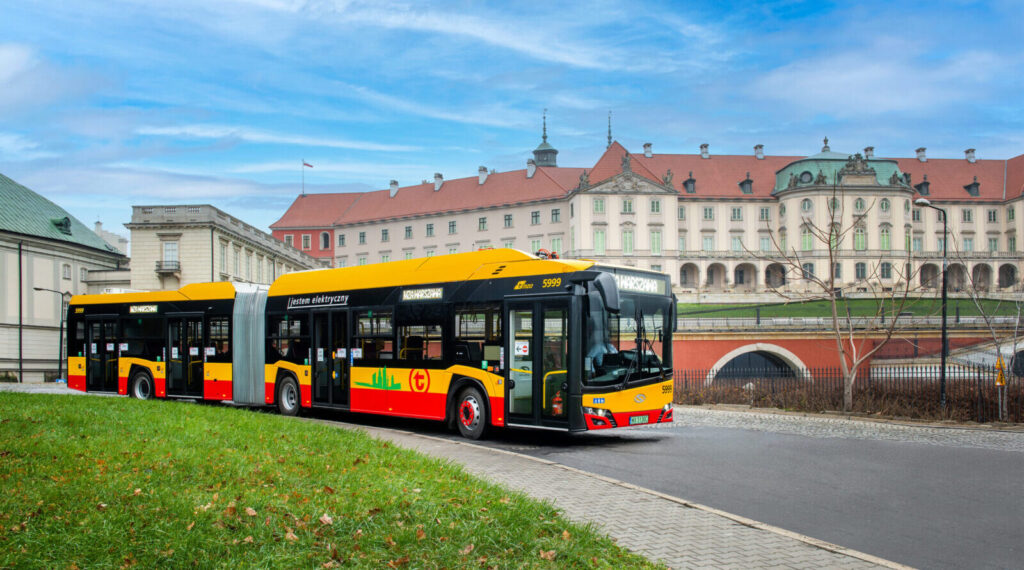
Warsaw’s Municipal Transport Authority (MZA) has recently added 50 electric buses from Solaris to its fleet, making it one of the cities with the largest electric bus fleets in Europe. However, a closer look at recent projects reveals that many Polish municipalities are failing to adhere to EU guidelines when selecting zero-emission vehicles.
A comparative review of eight municipal projects across Poland under the EU-funded Green Public Transport (ZTP) program shows a significant oversight: only one out of the eight cities made any energy or cost-efficiency comparison between battery-electric buses (BEVs) and hydrogen fuel-cell buses (FCEVs). Despite EU law mandating that all projects must prioritize Energy Efficiency First, this principle seems to have been ignored.
Starting in 2021 with the launch of ZTP, Poland has offered generous subsidies for zero-emission vehicles. However, these subsidies have inadvertently steered cities towards hydrogen fuel-cell buses over battery-electric alternatives due to higher funding percentages available—up to 90% for hydrogen buses compared to 80% for BEVs. This disparity in subsidy rates has created a financial incentive that favors less efficient technology.
Upon reviewing the feasibility studies from nine cities, including Kraków, Konin, Lublin, Piła, Płock, Poznań, Rybnik, Rzeszów, and Wejherowo, it became evident that there was a lack of thorough analysis. Most studies did not include any comparative energy or cost-efficiency data between BEVs and FCEVs, nor did they provide total cost of ownership (TCO) or primary-energy analyses. Instead, justifications for choosing hydrogen buses often relied on vague statements about range and refueling speed without concrete route-level modeling to support the claims.
Moreover, operational data from cities already utilizing both BEV and FCEV fleets revealed stark differences in efficiency. For instance, Białystok’s Yutong U12 electric bus fleet demonstrated an impressive energy consumption rate of 85–130 kWh per 100 km over a full year of operation. In contrast, hydrogen buses in Poland consumed roughly 490 kWh of electricity per 100 km when considering the full hydrogen chain from electrolysis to fuel cell usage.
The findings suggest that while hydrogen buses offer certain advantages like greater range and faster refueling times, they come with significantly higher energy consumption and operational costs. Cities are effectively prioritizing less efficient technology due to misguided financial incentives rather than making informed decisions based on lifecycle analysis as mandated by EU regulations.
As the reliance on green public transport intensifies across Europe, it is crucial for policymakers and city planners to reassess their funding mechanisms and ensure that they align with both environmental goals and fiscal responsibility. The current situation in Poland highlights a broader issue within European sustainability efforts and underscores the importance of adhering strictly to established guidelines.
In conclusion, while hydrogen buses may seem attractive due to their advanced technology and certain operational benefits, the reality is that battery-electric buses provide a far more efficient solution when considering total lifecycle energy use and costs. It’s time for cities to reassess their strategies and prioritize Energy Efficiency First in order to truly harness the full potential of green public transport.
