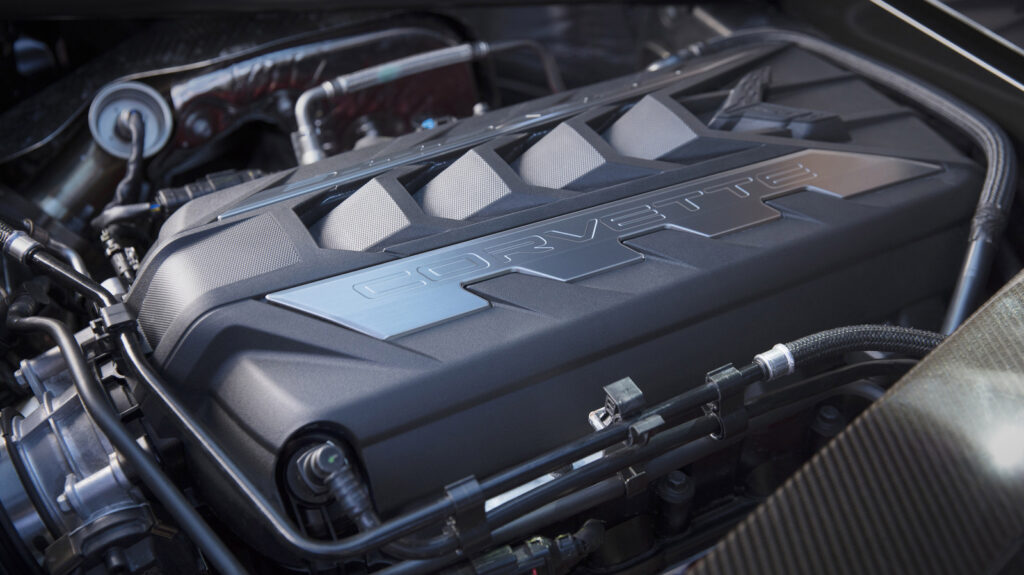
The Chevrolet LT1 and LT2 engines are both part of GM’s Gen V small-block engine family, but they differ significantly in design and performance to suit the changing demands of the Chevrolet Corvette over its generations.
Key Takeaways
- The LT1 and LT2 share a 6.2-liter displacement but feature different oil systems and mounting configurations.
- The LT2 includes a dry-sump oil system to ensure lubrication during aggressive handling, reducing the amount of oil needed compared to the LT1.
- Both engines are naturally aspirated with similar bore and stroke dimensions, maintaining the classic small-block architecture.
The Chevrolet LT1 engine was introduced in 2014 for the seventh-generation Corvette. It marked a significant redesign that improved upon the previous LS-series engines by enhancing power output and efficiency. The LT1’s design included advancements such as direct fuel injection, variable valve timing, and optimized internal components to achieve better performance.
For the eighth-generation Corvette, Chevrolet introduced the LT2 engine in 2020. This new engine was specifically designed for the car’s rear mid-engine configuration, necessitating a range of modifications from its predecessor. The most notable change is the implementation of a dry-sump oil system on the LT2, which ensures consistent lubrication even during high-stress maneuvers and rapid acceleration.
The physical dimensions between the LT1 and LT2 remain largely similar, with both engines featuring a 90-degree cylinder angle, identical bore (4.06 inches) and stroke (3.62 inches), and a compression ratio of 11.5:1. However, these similarities do not mean they are interchangeable or equivalent in performance capabilities. The LT2’s dry-sump system allows for better handling of extreme conditions that the front-engine Corvette could not fully utilize.
Despite sharing many characteristics with its predecessor and other variants like the twin-turbo LT7 found in the ZR1 model, the LT2 stands out due to its unique design requirements. This engine’s enhanced lubrication system makes it a more versatile powerplant for high-performance driving scenarios where consistent oil flow is critical.
Frequently Asked Questions
What are the main differences between LT1 and LT2 engines?
The primary difference lies in their oil management systems. The LT2 features a dry-sump system to ensure consistent lubrication during aggressive driving, while the LT1 relies on a wet-sump system.
Is the compression ratio different between LT1 and LT2?
No, both engines maintain an 11.5:1 compression ratio to optimize performance and fuel efficiency.
The Chevrolet LT1 and LT2 engines represent a continuum of technological advancement in Corvette powerplants, each tailored to the specific needs of its generation’s vehicle architecture.
