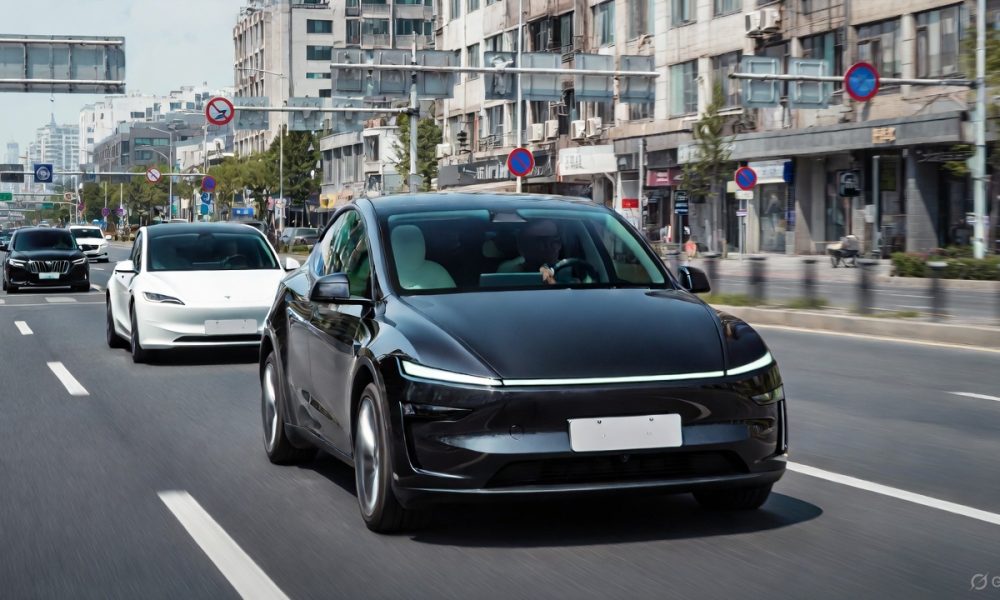
Tesla’s Model 3 and Model Y have once again proven their efficiency prowess in a recent real-world test conducted by Autohome, a leading Chinese automotive website. The results show that the Tesla duo outperformed other electric vehicles under identical conditions, highlighting their continued dominance in long-range efficiency.
Key Takeaways
- Tesla Model 3 recorded an impressive 20.8 kWh/100 km and the Model Y followed closely at 21.8 kWh/100 km in Autohome’s test.
- Xiaomi CEO Lei Jun acknowledged Tesla’s efficiency lead but pledged to continue improving his company’s vehicles.
- The test underscores that drivetrain optimization, software management, and aerodynamic design play crucial roles in maintaining low energy consumption at high speeds and cold temperatures.
Autohome’s rigorous testing involved all cars under identical conditions: a full 375-kg load, cabin temperature set to 24°C on automatic climate control, and cruising speed maintained at 120 km/h. Under these challenging circumstances, the Tesla Model 3 emerged as the clear winner with an efficiency rating of 20.8 kWh/100 km, while the Model Y came in second with a slightly higher but still impressive score of 21.8 kWh/100 km.
Xiaomi’s Lei Jun, CEO and founder, was quick to acknowledge Tesla’s superior performance. Despite noting that his company’s SU7 performed well overall, he admitted that its larger size and higher specifications contributed to the increased energy consumption compared to the Teslas. Nonetheless, Lei Jun emphasized Xiaomi’s commitment to learning from Tesla and improving their own vehicles.
The test revealed several key factors influencing electric vehicle efficiency: drivetrain optimization, software management, and aerodynamic design all play critical roles in maintaining low energy consumption during high-speed driving and cold weather conditions. These elements are particularly challenging for many EVs but seem less problematic for the Tesla Model 3 and Model Y.
Lei Jun’s comments reflect a broader industry trend where Chinese automakers are increasingly looking to benchmark their vehicles against global leaders like Tesla. This competitive spirit is likely to drive further innovation in electric vehicle technology, benefiting consumers with more efficient and affordable options.
Frequently Asked Questions
What were the test conditions for Autohome’s efficiency tests?
The vehicles underwent testing under identical conditions: a full 375-kg load, cabin temperature set to 24°C on automatic climate control, and cruising speed maintained at 120 km/h.
How did Xiaomi’s Lei Jun respond to Tesla’s performance?
Xiaomi CEO Lei Jun acknowledged Tesla’s superior efficiency but noted that his company’s SU7 performed well overall. He emphasized the importance of size and specifications in energy consumption differences, while pledging continued improvement.
As Chinese automakers like Xiaomi continue to refine their electric vehicles, it is clear that Tesla remains a benchmark for efficiency and performance. These tests not only highlight Tesla’s strengths but also spur innovation across the industry, ultimately benefiting consumers with more efficient electric cars.
