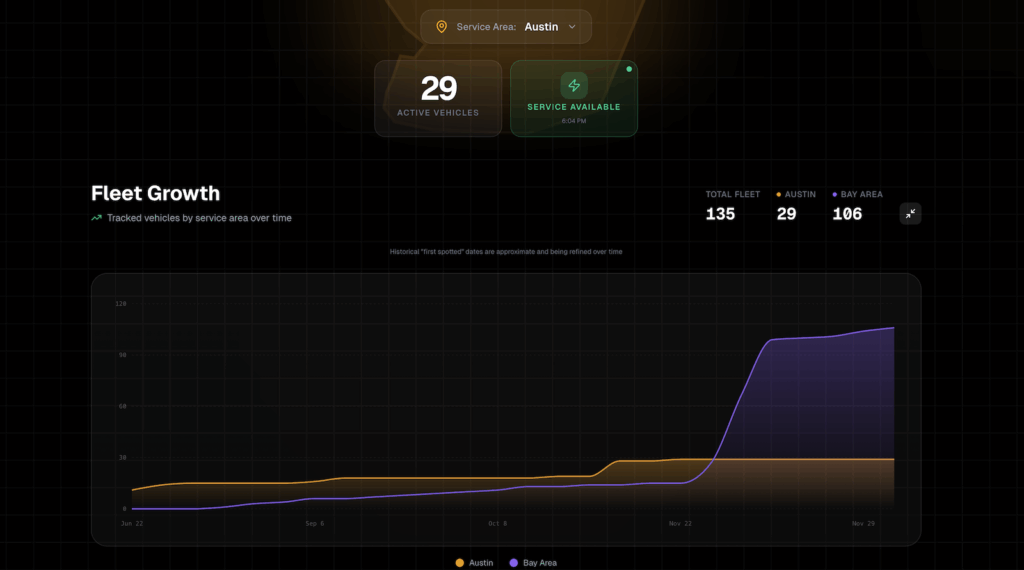
Tesla has increased its fleet of robotaxis operating in Austin, Texas, to a total of 29 vehicles as of December 1, 2025. This expansion comes after Elon Musk’s recent statement that the number of test cars would roughly double by the end of the year.
Key Takeaways
- Tesla has 29 robotaxis currently in operation in Austin, Texas.
- The company aims to have 500 robotaxi vehicles in Austin by the end of 2025 but is unlikely to meet this target.
- Deutsche Bank predicts up to 1,500 Tesla robotaxis could be roaming San Francisco and Austin before 2026.
The current fleet of Tesla’s robotaxi prototypes includes human safety drivers who monitor the vehicles’ performance. Despite Musk’s promise that these cars would become fully autonomous by December 2025, it appears that this goal may not be met due to ongoing challenges with safety and reliability.
According to a crowdsourced effort tracking Tesla’s robotaxi license plates, there are currently 106 test vehicles operating in the San Francisco Bay Area. This indicates a significant disparity between the company’s ambitious plans and its current operational capacity. The tracker also reveals that several accidents have occurred with these test vehicles recently.
Despite the setbacks, Tesla continues to push forward with its robotaxi program. The company is leveraging this technology as part of its broader strategy to revolutionize urban transportation. However, achieving full autonomy remains a complex challenge, especially given the regulatory and safety hurdles that must be overcome.
Frequently Asked Questions
How many Tesla robotaxis are currently in operation?
Tesla has 29 robotaxi vehicles operating in Austin, Texas, and 106 in the San Francisco Bay Area as of December 1, 2025.
When is Tesla expected to remove human safety drivers?
Tesla aimed to eliminate human safety drivers by December 2025 but it’s unclear if this goal will be met due to recent accidents and technical challenges.
The expansion of Tesla’s robotaxi fleet in Austin is a significant step towards the company’s vision of autonomous transportation. However, achieving full autonomy remains uncertain as the company faces ongoing safety concerns and regulatory hurdles.
