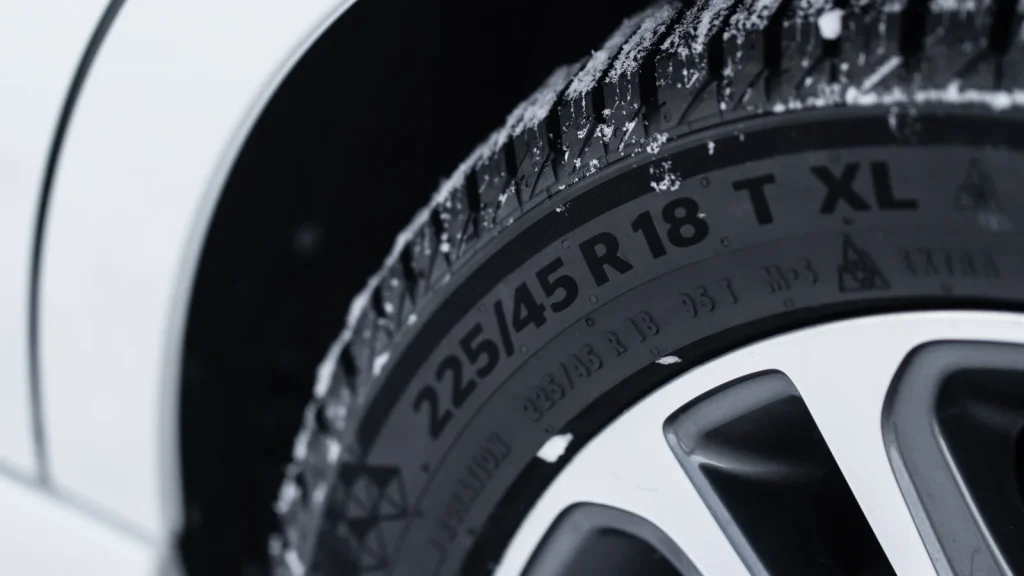
Have you ever stared at your tire’s sidewall, feeling lost among a sea of numbers and letters? It’s like trying to decipher an ancient language. But fear not! These markings are actually a cheat sheet for ensuring your vehicle is running smoothly.
Key Takeaways
- The first letter indicates the tire type, such as P for passenger cars or LT for light trucks.
- The numbers 275 and 40 represent the width in millimeters and aspect ratio of your tires, respectively.
- A wheel diameter like 18 inches is crucial for fitting new wheels correctly on your car.
Let’s start with the basics. The letter at the beginning—P, T, or LT—is a clue to what kind of vehicle you’re dealing with. P stands for passenger cars and is probably what most people see every day. If it’s an LT, that means we’re talking about something bigger like a truck.
The next part gets into specifics: 275/40 R18. The number 275 tells you how wide the tire is in millimeters from one side to another. That’s important if you’re thinking of swapping out your wheels for something sportier or wider. And then we have that mysterious 40, which is actually a percentage showing how tall the sidewall is compared to its width.
After those numbers comes an R and a number like 18. The letter R stands for radial construction—a common type of tire where rubber cords are laid straight across from side-to-side on your wheel. That’s different from D, which means diagonal ply tires. And the big round number at the end? It’s telling you how many inches wide your wheels need to be.
Now, why does all this matter? Well, if you’re looking for new tires or even just changing out a flat, getting these details right can mean the difference between smooth sailing and major headaches. And while it might seem overwhelming at first, once you understand what each part means, choosing the right tire becomes much easier.
Frequently Asked Questions
What does a P275/40 ZR18 89Y mean?
The ‘P’ indicates it’s for passenger cars, the numbers represent width and aspect ratio, R means radial construction, 18 is wheel diameter in inches, and Y is speed rating.
Can I mix different tire sizes on my car?
Mixing tire sizes can affect your vehicle’s handling. It’s best to stick with the same size all around for safety reasons unless you know exactly what you’re doing and have a specific reason.
Tires are more than just rubber circles that spin; they’re crucial components of how well your car performs on any road, whether it’s wet or dry. So next time you find yourself staring at those cryptic markings, remember: understanding them is key to keeping your ride safe and happy.
