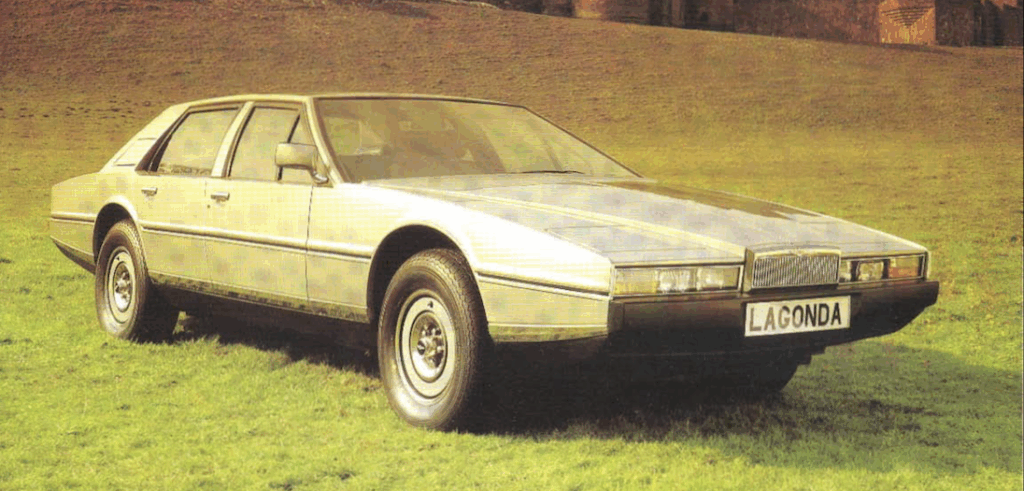
The Aston Martin Lagonda, introduced in 1976, stands as a testament to bold automotive design and technological innovation. Its wedge-shaped form and digital instrumentation were groundbreaking for their time, setting it apart from traditional luxury sedans like those from Mercedes-Benz and Rolls-Royce.
Key Takeaways
- The Lagonda’s distinctive design was a radical departure from conventional luxury cars of the era.
- Digital instrumentation, an avant-garde feature in the 1970s, made it a pioneer in automotive technology.
- The car’s reliability issues were symptomatic of its cutting-edge nature and early adoption of advanced electronics.
When Aston Martin unveiled the Lagonda, it was clear that this wasn’t your typical luxury sedan. Chief designer William Towns crafted an origami-sharp wedge with flat surfaces and futuristic proportions, making it look more like a spacecraft than a car. The exterior design was revolutionary for its time, challenging the traditional upright forms of other high-end vehicles.
Underneath its striking appearance lay advanced technology that would become commonplace decades later. Aston Martin collaborated with aerospace suppliers to create an instrument cluster featuring vacuum-fluorescent displays and touch-sensitive controls. This digital dashboard was a technological moonshot in an era when computers were still rare, making the Lagonda feel like it had stepped straight out of a science fiction movie.
Despite its futuristic appeal, the Lagonda faced significant challenges due to its reliance on cutting-edge electronics. Fragile components and overheating issues plagued early models, leading to reliability problems that frustrated owners accustomed to more straightforward mechanical systems. However, when everything worked as intended, the car offered a glimpse into an automotive future that would only become fully realized in the 2000s.
At its core, the Lagonda remained true to Aston Martin’s heritage with a powerful 5.3-liter V8 engine capable of delivering smooth torque and impressive performance figures. This blend of traditional luxury car attributes and forward-thinking technology made it an intriguing proposition for enthusiasts and collectors alike.
Frequently Asked Questions
What makes the Aston Martin Lagonda unique?
The Lagonda’s uniqueness stems from its radical design, which was a departure from traditional luxury car aesthetics. It also featured advanced digital instrumentation that was far ahead of its time.
Why did early models have reliability issues?
The electronic systems used in the Lagonda were highly advanced for their era and prone to failure due to fragility and overheating, leading to significant reliability challenges.
In conclusion, the Aston Martin Lagonda remains a fascinating chapter in automotive history. Its bold design and pioneering technology continue to captivate enthusiasts, even as it serves as a reminder of the risks associated with pushing boundaries too far ahead of their time.
