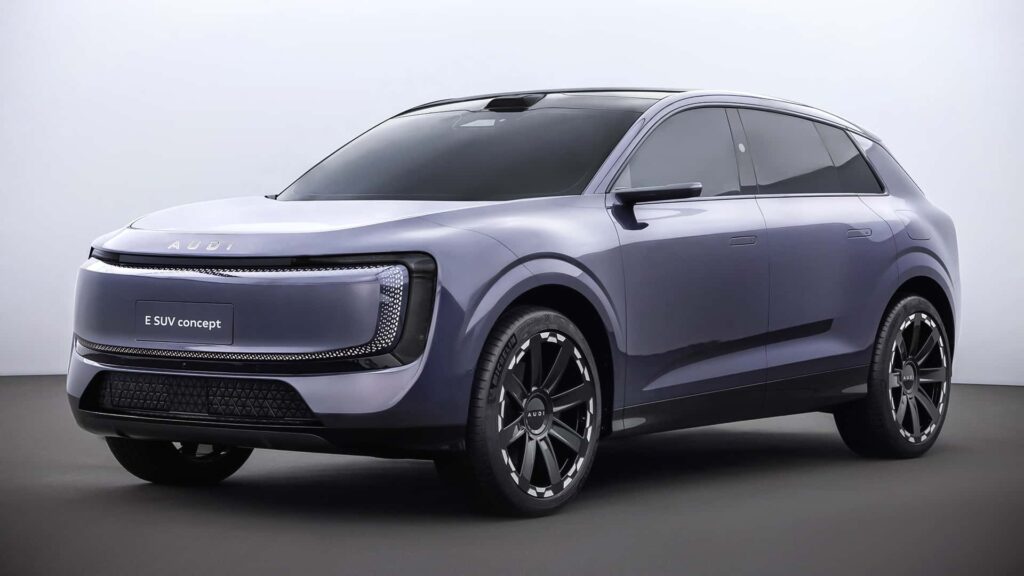
Audi is making waves in the Chinese market by launching another model under its newly created AUDI sub-brand, this time a fully electric SUV that will debut at Auto Guangzhou 2025. It’s part of their strategic pivot to cater directly to China’s unique tastes and demands.
The new E SUV Concept is a massive vehicle, outsizing even the Q8 e-tron that Audi recently discontinued. With dimensions of 5057mm long, 2042mm wide, and 1786mm high, it’s built to offer generous rear legroom, a feature Chinese buyers adore.
The design is a clean break from the traditional Audi look. No more iconic Four Rings here; instead, the front grille proudly displays ‘AUDI’ in large letters. It’s sleek and minimalist with flush door handles, slim C-shaped lighting elements, and roof-mounted LiDAR pods that hint at advanced driver assistance systems.
What’s really interesting is that this SUV isn’t just a styling exercise; it’s built on SAIC’s new Advanced Digitized Platform (ADP). That means Audi is fully committing to Chinese manufacturing for its AUDI-branded vehicles. No more imported models, no global strategy here—just pure China-centric engineering.
The E SUV will be available with a powerful dual-motor setup that offers all-wheel drive and a respectable 0-100km/h acceleration time of five seconds. But the real kicker is its battery pack: a hefty 109kWh unit that promises an impressive range of up to 700km on the CLTC cycle, with fast-charging capabilities adding up to 320km in just ten minutes.
Let’s talk about why this matters. Audi has been struggling to keep pace with local EV players like NIO and BYD in China. By creating its own sub-brand tailored specifically for Chinese buyers, it’s positioning itself not as a foreign luxury brand but as an indigenous player that understands the market intimately.
Expect some heated competition from other premium brands vying for the same space. BMW’s iX5 is already here and Tesla’s Model Y continues to dominate sales figures. But with its AUDI sub-brand, Audi seems ready to play this game on China’s home turf. We’ll have to wait until 2026 to see how well it performs.
