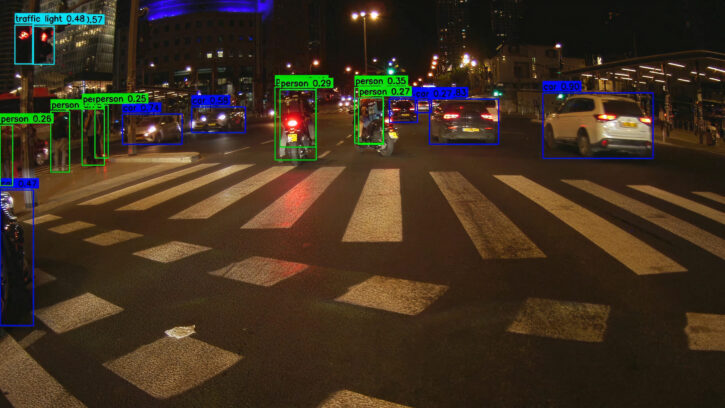
The autonomous vehicle (AV) industry is grappling with the challenge of managing petabyte-scale video data, which strains infrastructure and increases costs. Beamr’s Dani Megrelishvili recently discussed their content-adaptive bitrate technology that aims to alleviate these issues by compressing video data without compromising machine learning model accuracy.
Key Takeaways
- Beamr’s technology reduces storage and transfer costs for AV companies managing petabyte-scale datasets.
- The compression method is content-adaptive, ensuring that different video scenes are compressed with optimal parameters to maintain model performance.
- Petabyte-scale data management challenges include high cloud storage fees, network transfer limitations, and infrastructure scaling pressure.
Beamr’s technology offers a solution by compressing video data without significantly impacting the accuracy of machine learning models used in autonomous vehicles. For instance, a 150-vehicle fleet producing 1TB of data per day would generate 55 petabytes annually, leading to substantial storage and processing costs.
Compared to traditional compression methods, Beamr’s approach is more precise as it adjusts the bitrate based on content complexity, ensuring that critical details in complex scenes are preserved. This adaptability is crucial for AV applications where maintaining object recognition accuracy at various distances is paramount.
The economic benefits of such a solution are significant. For companies managing hundreds of petabytes of real-world and synthetic video data, annual costs can range from millions to tens of millions of dollars. By reducing these datasets through efficient compression, Beamr’s technology promises substantial savings in cloud storage fees and network transfer expenses.
However, the implementation of any new compression method requires rigorous validation to ensure it does not compromise model integrity or performance. Industry experts emphasize that standard tools often lack the precision needed for machine learning workloads, making content-adaptive solutions like Beamr’s essential for AV development.
Frequently Asked Questions
How does Beamr’s compression technology compare to traditional methods?
Beamr’s technology is more precise and content-adaptive, adjusting bitrate based on scene complexity. Traditional methods apply uniform parameters that can degrade model accuracy in complex scenes.
What are the potential cost savings for AV companies using Beamr’s solution?
The exact savings vary by company size and data volume but could range from millions to tens of millions of dollars annually in cloud storage fees, network transfer expenses, and compute overhead.
In conclusion, as autonomous vehicle fleets grow, the need for efficient video data management becomes increasingly critical. Beamr’s content-adaptive compression technology offers a promising solution that balances cost reduction with maintaining model performance integrity.
