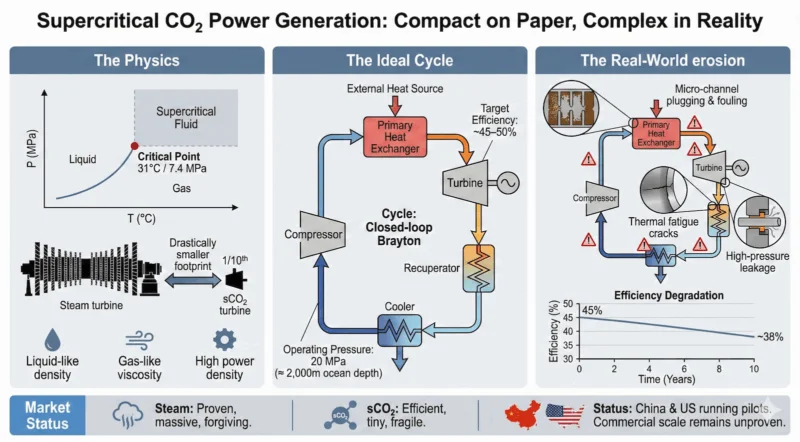
China has just added a supercritical carbon dioxide power generator to its energy mix, but will it stick around? The Chaotan One plant in Guizhou province aims to turn waste heat into electricity with impressive efficiency claims. But past performance suggests caution.
Key Takeaways
- The new generator promises up to 30% better conversion of industrial waste heat than steam-based systems.
- This tech has been hailed as a breakthrough, but China’s history shows it won’t automatically mean widespread adoption.
- The real test is whether the plant can operate reliably over time and prove its worth economically.
China’s approach to new technology often involves building first-of-a-kind systems just to see what works. It’s a strategy that allows for learning, but also leads to many dead ends. This supercritical CO₂ generator is the latest example of this method in action.
The plant at Chaotan One promises significant improvements over existing waste heat recovery methods by converting industrial waste into electricity more efficiently. If successful, it could reduce energy costs and lower emissions for industries like steel manufacturing. But past projects hint that success isn’t guaranteed just because China built something first.
China has experimented with other cutting-edge technologies before, such as small modular reactors (SMRs) and molten salt reactors. Despite having the resources to scale them up if they worked well, these efforts have not led to widespread use yet. This raises questions about whether this supercritical CO₂ generator will be any different.
It’s tempting for Western tech advocates to point at China’s limited deployments as proof of viability, but that could be misleading. The real test lies in how the technology performs over time and proves its economic value. If it can do both, then we might see more supercritical CO₂ generators popping up around the world.
Frequently Asked Questions
How much power does one unit of this generator produce?
The Chaotan One plant’s units are each rated at about 15 MW, with configurations totaling around 30 MW.
What kind of improvements in efficiency is the supercritical CO₂ system expected to deliver compared to traditional methods?
The generator promises a heat-to-power conversion improvement ranging from 20% to over 30%, which could make it highly attractive for waste heat recovery.
Only time will tell if this new technology can live up to its promise and become the next big thing in energy production, or if it’s just another dead end on China’s tech learning curve.
