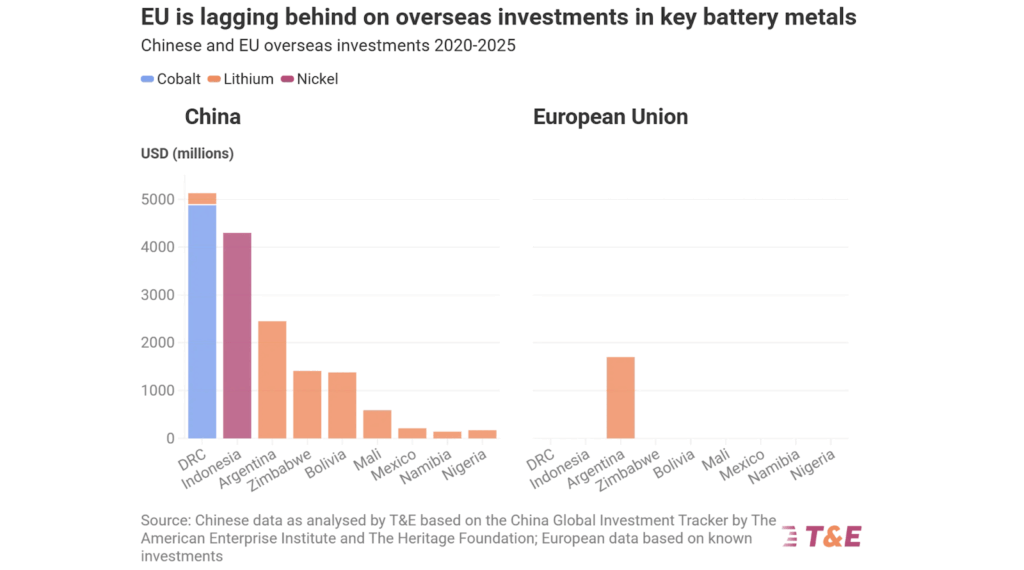
As Europe races to secure critical raw materials for clean energy technologies, a recent study by Transport & Environment (T&E) highlights the EU’s struggle in effectively financing mineral projects. The report reveals that while several initiatives aim at building resilient supply chains, concrete progress is lacking compared to overseas investments.
Key Takeaways
- The European Union has invested only USD1.7 billion in critical raw materials since 2020, all of it in Argentina, while China has invested over USD15 billion globally.
- Eurozone Export Credit Agencies (ECAs) have played a limited role in the extractive sector for critical raw materials despite their potential to de-risk projects and mobilize significant capital.
- There is no cohesive EU strategy or mechanism to deploy ECAs’ collective EUR 100bn financing support strategically, leading to fragmented efforts across member states.
The study underscores the disparity between European ambitions and actual investments in critical raw materials. Since 2020, China has made substantial strides by investing over USD15 billion globally in key battery metals projects. In contrast, EU companies have only invested USD1.7 billion, all of which was directed towards Argentina.
European Export Credit Agencies (ECAs) are pivotal players in de-risking large-scale extractive sector investments but have been underutilized for critical raw materials. Despite the potential to mobilize significant capital and support responsible mineral projects, ECAs’ involvement remains limited. This is particularly evident when comparing their activities with those of China or the US.
The report also highlights a lack of EU-level coordination in deploying ECAs’ collective EUR 100bn financing support strategically. In contrast to ‘whole-of-government approaches’ adopted by countries like China, the United States, and Canada, Europe has not yet managed to mobilize ECAs alongside Development Finance Institutions (DFIs) or private investors effectively.
Under initiatives such as Global Gateway, EU’s response to Chinese Belt and Road, ECA participation may represent only a very small share of their overall activity. This fragmentation hampers the EU’s ability to catch up with overseas investments in critical raw materials, undermining its efforts to secure diverse supply chains for clean energy technologies.
Frequently Asked Questions
How much has China invested in key battery metals projects since 2020?
China has invested over USD15 billion globally in key battery metals projects since 2020.
What is the total financing support managed by EU ECAs collectively?
The European Export Credit Agencies (ECAs) collectively manage over EUR 100bn in official financing support.
In conclusion, while Europe’s initiatives to secure critical raw materials are commendable, the current approach lacks coherence and strategic deployment of available resources. Addressing these issues will be crucial for Europe’s transition towards clean energy technologies and ensuring a sustainable future.
