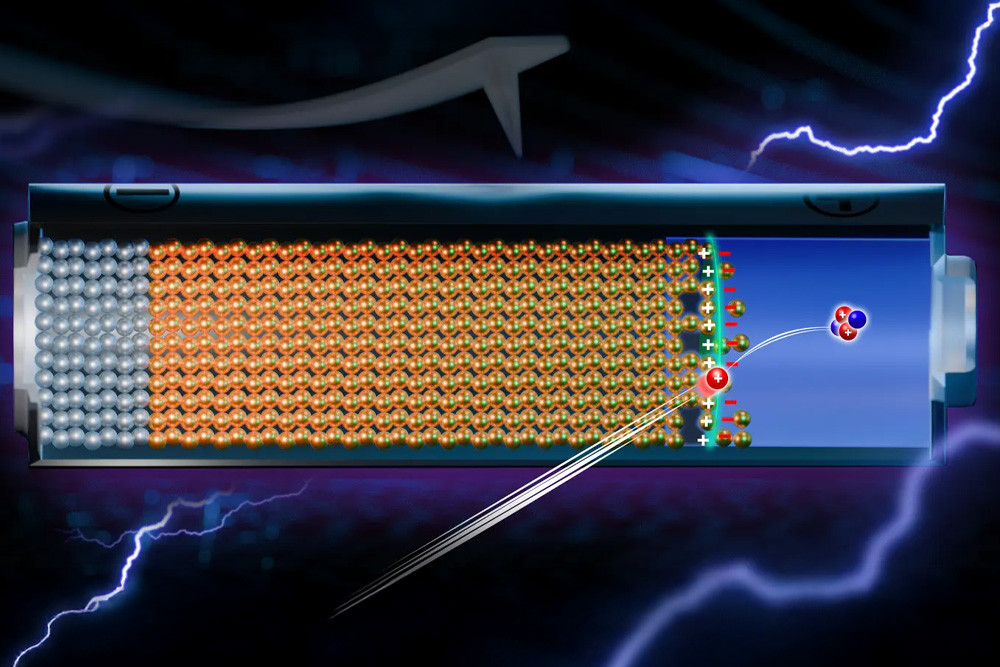
Researchers from the Max Planck Institute for Polymer Research (MPI-P) in Germany and their Japanese counterparts have made significant progress in understanding space charge effects within solid-state batteries. Their findings, published in the journal ‘ACS Nano,’ offer insights that could enhance battery performance by reducing internal resistance.
Key Takeaways
- The research team successfully measured the spatial extent and resistance of space charge zones for the first time.
- The study reveals that these effects are most pronounced at the positive electrode, forming a layer less than 50 nanometers thick.
- The findings could lead to improvements in solid-state battery performance by modifying electrode structures or materials.
Space charge effects introduce additional resistance during charging and discharging of solid-state batteries. The MPI-P team used advanced microscopic techniques to determine the extent of these zones, which account for about seven percent of a battery’s total internal resistance. This layer is dynamic, changing its behavior based on the state of charge.
The research highlights that while space charges are most significant at the positive electrode, their impact varies with electrolyte materials. Understanding this variability could enable more precise engineering of solid-state batteries to optimize performance and efficiency.
Comparative studies show that lithium-ion batteries often face similar issues but in a different context, primarily due to liquid electrolytes which can lead to dendrite formation. Solid-state batteries aim to mitigate these risks by using solid electrolytes, yet the new findings indicate there are still challenges related to internal resistance and efficiency.
Despite the progress made by MPI-P and their Japanese partners, other research institutions around the world continue to explore similar issues. For instance, studies at Stanford University focus on improving ion conductivity in solid-state batteries through material innovation.
Frequently Asked Questions
What is a space charge layer?
A space charge layer forms within the battery during charging and discharging, primarily at interfaces between different materials. It introduces additional resistance that can reduce overall efficiency.
How does this research impact solid-state batteries?
The findings provide a clearer understanding of internal resistances in solid-state batteries, which could lead to more efficient designs and better performance by modifying electrode materials or structures.
This study marks an important step towards optimizing the efficiency and power density of solid-state batteries. Further research will be necessary to translate these insights into practical applications that enhance battery technology for automotive and other industries.
