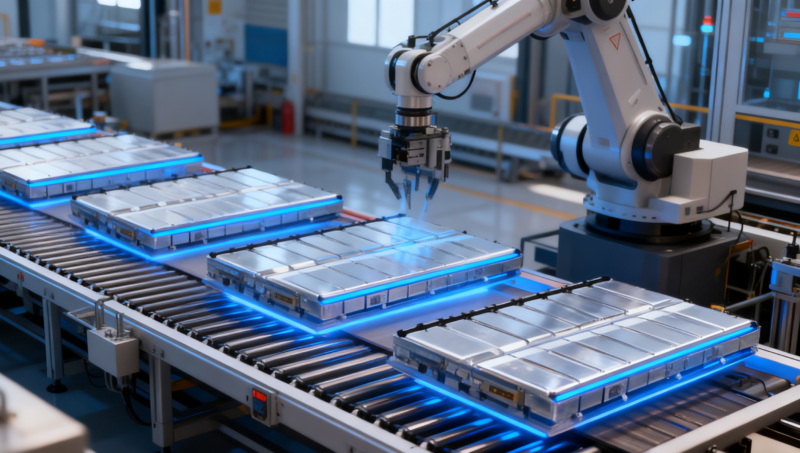
Jiangxi Province in China is set to become a hub for solid-state battery production, with two major projects aiming to add 3 GWh of capacity. This surge in manufacturing could significantly impact the electric vehicle (EV) supply chain and accelerate mass production timelines.
Key Takeaways
- Jiangxi will see a total of 3 GWh solid-state battery capacity from two projects.
- A subsidiary of Pure Lithium New Energy plans to build a 1 GWh plant in Huko County.
- Sanwei Battery (Shaanxi) is developing a 2 GWh facility with an investment of 17 billion yuan.
The first project, led by a subsidiary of Pure Lithium New Energy, will establish a solid-state battery plant in Jiangxi’s Huko County. The factory aims to produce 1 GWh annually once completed and is expected to start small-scale testing in 2026 with potential vehicle integration trials in 2027.
Meanwhile, Sanwei Battery (Shaanxi) is advancing a separate initiative in Jiangxi’s Yugan High-Tech Zone. This project includes building an R&D center and smart manufacturing base, targeting EV applications with 2 GWh annual production capacity once fully operational.
The projects highlight the growing focus on solid-state battery technology in China’s EV sector. Solid-state batteries offer higher energy density and improved safety compared to traditional lithium-ion batteries, making them highly sought after for future EV models.
Other provinces are also expanding their battery manufacturing capacities. For instance, Ya’an is planning a 40,000-ton LMFP cathode project, while Shandong aims to build a high-energy-density cylindrical cell line with 3 GWh capacity, showcasing the diversification of China’s EV supply chain.
Frequently Asked Questions
When will small-scale testing begin for the Pure Lithium New Energy project?
The small-scale testing phase is scheduled to start in 2026, with potential vehicle integration trials following in 2027.
What is the total investment by Sanwei Battery (Shaanxi) for their solid-state battery initiative?
The project involves an investment of 17 billion yuan, approximately $2.43 billion USD.
These projects underscore China’s commitment to advancing EV technology and establishing itself as a leader in the global EV market. As more capacity comes online, consumers can expect to see more affordable and efficient electric vehicles hitting the roads in the coming years.
