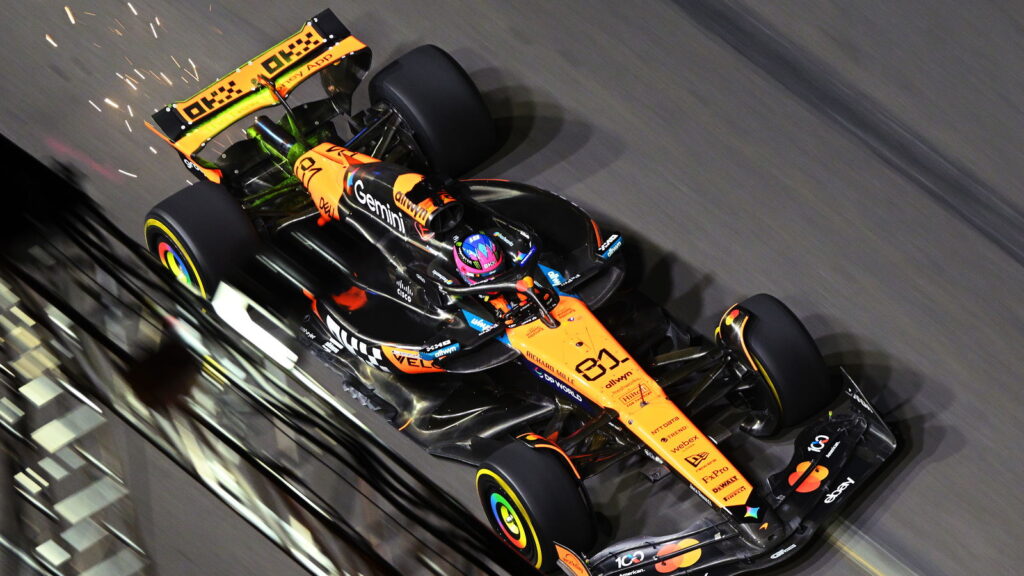
McLaren has detailed the reasons behind their double disqualification at the recent Formula One (F1) Las Vegas Grand Prix, where both Lando Norris and Oscar Piastri were disqualified for excessive wear to their skid blocks. The team’s findings indicate that unexpected porpoising caused by race conditions led to the technical infringement.
Key Takeaways
- Mclaren realized early in the race that both cars were experiencing high levels of porpoising, causing excessive wear to skid blocks.
- The team added a safety margin for clearance to the ground compared to practice sessions but was negated by unexpected vertical oscillations.
- McLaren argues they did not take excessive risks with ride height settings despite disrupted practice sessions due to wet weather and red flags.
According to McLaren team principal Andrea Stella, data collected during the race showed that porpoising was a significant concern from early laps. The issue was exacerbated by conditions unseen in practice, leading both drivers to take remedial actions which were ultimately ineffective. “We saw an unexpected level of porpoising inducing large vertical oscillations,” said Stella.
Despite losing one sensor on Piastri’s car that monitored the skid block wear, McLaren managed to gather enough data from Norris’ vehicle through telemetry. The team had initially planned for a conservative approach with clearance settings but found themselves unable to mitigate the unforeseen porpoising adequately.
The FIA’s post-race investigation confirmed that both cars exceeded the allowed wear limits on their skid blocks, leading to disqualification. McLaren’s findings suggest that the unexpected nature of the race conditions played a critical role in this infringement, as they had not anticipated such high levels of porpoising based on practice sessions.
Frequently Asked Questions
Did McLaren take risks with their setup?
No, McLaren stated that despite disrupted practices due to wet weather and red flags, they added a safety margin for clearance compared to practice sessions. However, unexpected vertical oscillations negated these precautions.
What caused the excessive porpoising?
The exact cause of extensive porpoising was not anticipated based on pre-race data and conditions. McLaren noted that race day conditions exacerbated this issue leading to high levels of skid block wear.
This incident highlights the unpredictable nature of F1 racing, where unexpected conditions can lead to technical infringements despite conservative approaches by teams. McLaren’s detailed analysis provides insight into how unforeseen circumstances can impact a car’s performance and compliance with regulations.
