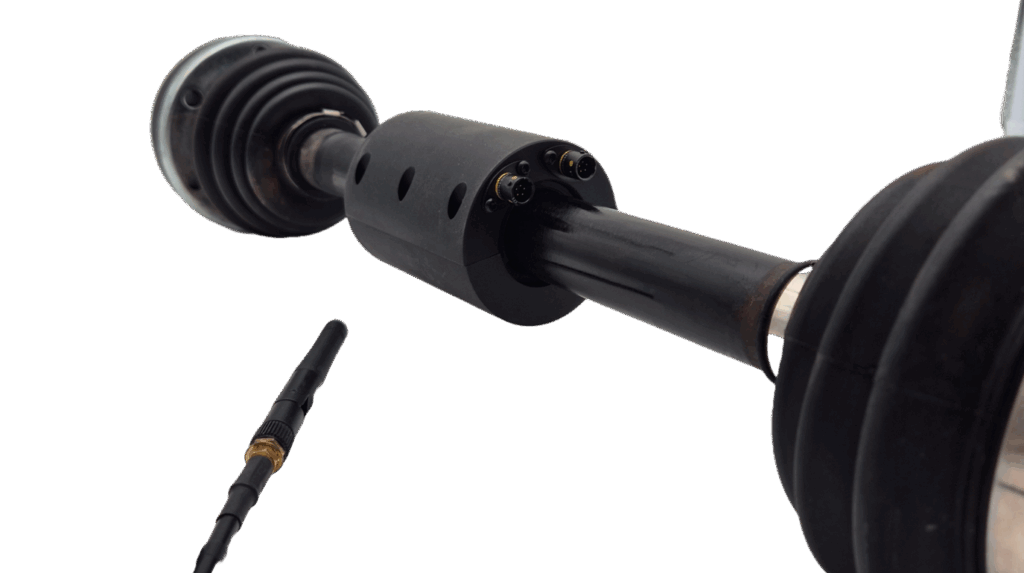
Automotive engineering has seen a significant advancement with the introduction of Melectric Systems’ new driveshaft torque sensor, the ME-DST. This innovative product aims to bridge the gap between laboratory-grade precision and real-world durability, catering to the growing complexity of modern driveline architectures.
Key Takeaways
- The ME-DST offers a modular rotor unit that can be customized for various shaft diameters and shapes.
- Data transmission is available through either 2.4GHz radio telemetry or inductive near-field interface, catering to different testing environments.
- The sensor’s electronics are housed in sealed enclosures rated up to IP65/67, ensuring reliability under harsh conditions.
At the heart of the ME-DST is a modular rotor unit that mounts directly onto the driveshaft. Its design allows for customization based on specific application needs, accommodating various shaft diameters and shapes. This flexibility ensures compatibility with diverse testing scenarios, from compact electric vehicles to large commercial trucks.
The sensor’s data transmission capabilities are equally versatile. For on-road applications, a 2.4GHz radio telemetry link provides interference-resistant wireless signal transmission at sampling rates up to 10kHz over distances of up to 10 meters. This makes it ideal for dynamic testing environments where continuous monitoring is crucial.
For long-duration or high-dynamics applications such as engine and driveline test benches, the inductive near-field interface offers a reliable solution. It supplies continuous power across a typical rotor-stator distance of around 10mm, ensuring uninterrupted data acquisition even under demanding thermal and mechanical conditions.
The ME-DST’s electronics are housed in sealed enclosures rated up to IP65/67, making them suitable for use in harsh environments. The system processes strain-gauge signals with high stability, providing accurate torque readings during rapid load changes or dynamic torsional oscillations. This level of precision is essential for modern vehicles with increasingly complex driveline systems.
Frequently Asked Questions
How does the ME-DST handle different testing environments?
The ME-DST offers two data transmission methods: a 2.4GHz radio telemetry link for on-road applications and an inductive near-field interface for test bench scenarios, ensuring reliable performance across various conditions.
What are the customization options available for the rotor unit?
The rotor module can be customized to fit different shaft diameters and shapes, allowing it to integrate seamlessly into tight or unconventional spaces commonly found in modern vehicle designs.
In conclusion, Melectric Systems’ ME-DST driveshaft torque sensor represents a significant leap forward in automotive testing technology. By combining laboratory-grade accuracy with real-world durability, the ME-DST offers engineers and researchers an invaluable tool for advancing the next generation of vehicles.
