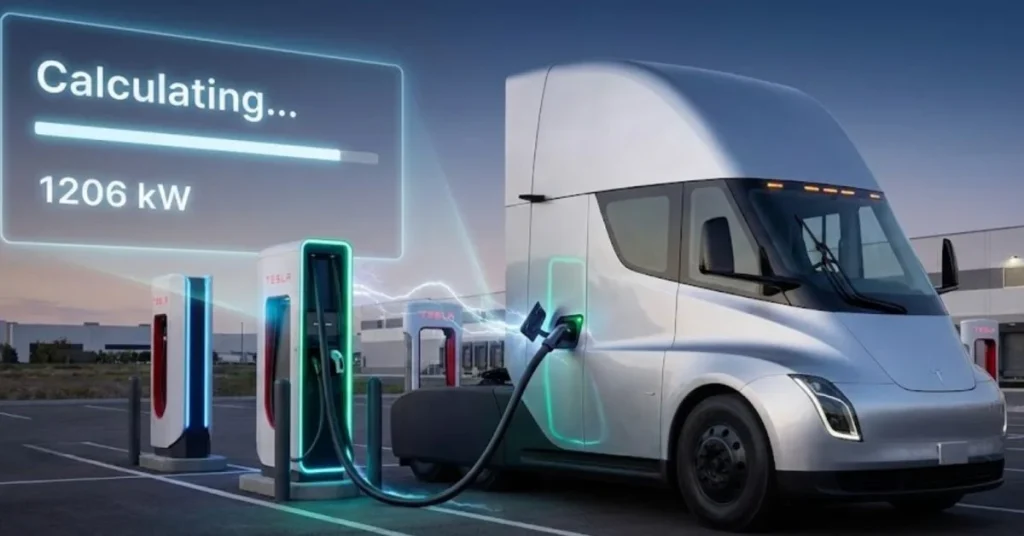
Tesla has released a video showcasing its semi-truck, the Tesla Semi, charging at an unprecedented rate of 1.2 megawatts (MW), marking significant progress towards long-haul electric trucking capabilities.
Key Takeaways
- Tesla’s new video reveals a peak charge rate for the Tesla Semi at 1.2 MW, matching its announced Megacharger capacity.
- The charging system can deliver up to 500 kW for cars and 1.2 MW for trucks using V4 Cabinet architecture.
- With this speed, the truck could potentially achieve a 10-80% charge in under 45 minutes with an estimated battery pack of around 850 kWh.
Tesla’s official account on X shared footage showing engineers monitoring a charging session where power output reached up to 1.2 MW, aligning with the company’s previously announced capabilities for its V4 Cabinet architecture.
The video highlights Tesla’s Megacharger system and its liquid-cooled cable designed specifically to handle such high-power outputs without overheating issues. However, details about battery state-of-charge during peak charging remain undisclosed.
For a truck with an estimated 500-mile range on a single charge, reaching the target of adding 70% more range in just half an hour requires sustained power delivery at these high levels without compromising safety or performance.
Tesla aims to start production of the Tesla Semi by mid-2026 as it ramps up capacity at its Nevada factory expansion. The company has already delivered several units to partners like PepsiCo for real-world testing, but this is one of the first public demonstrations of charging efficiency on such a scale.
Frequently Asked Questions
What’s the peak power output Tesla Semi can achieve?
The official video shows that the truck reaches up to 1.2 MW, or 1,206 kW.
How long does it take for a 10-80% charge at this rate?
If sustained without tapering off too quickly, the Semi could theoretically achieve that range in under 45 minutes based on its battery capacity of around 850 kWh.
The release of such high-power charging capabilities signals Tesla’s commitment to advancing electric vehicle technology for commercial use and sets a new standard for long-haul trucking efficiency.
