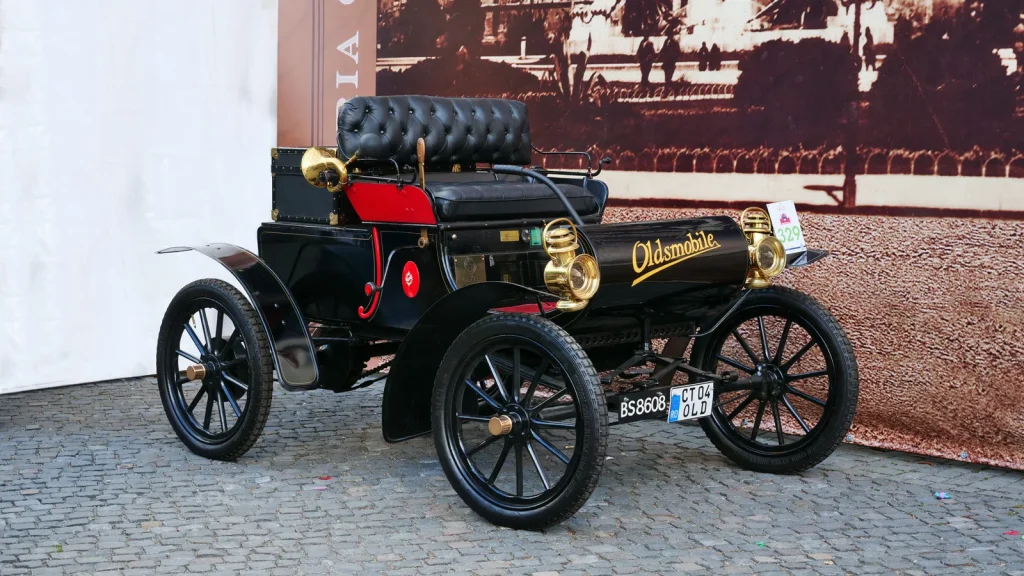
The 1901 Curved Dash Oldsmobile is a fascinating relic that harkens back to an era when automotive engineering was in its infancy. This early model, powered by a single-cylinder engine and boasting just 4.5 horsepower, stands as a testament to the ingenuity of automakers at the dawn of the automobile age.
Key Takeaways
- The Curved Dash Oldsmobile has a unique footboard design that gives it its name.
- Ransom Olds developed nearly a dozen prototypes before settling on the Curved Dash after his factory burned down in 1901.
- This early car was steered by a tiller, not a steering wheel.
The Curved Dash wasn’t just any old car. It had an engine that produced only 4.5 horsepower and operated at around 500 RPM, making it sound like a chugging machine more than anything else on the road back then. But despite its modest power output, this little Oldsmobile became quite popular.
What made Ransom Olds choose the Curved Dash over his other prototypes? The answer lies in tragedy: a fire destroyed his factory in 1901, leaving only one model untouched—the Curved Dash. This accident forced him to focus all production efforts on this particular car.
The Curved Dash’s design included no steering wheel; instead, it featured a tiller that allowed drivers to control the direction of their vehicle with significant effort. The lack of modern amenities like power brakes and air conditioning made driving one of these cars an experience unlike anything today’s motorists know.
Frequently Asked Questions
Was the Curved Dash Oldsmobile safe to drive?
The safety standards for early automobiles were practically non-existent, so while it was street-legal and sold by the thousands, drivers needed a lot of skill and patience.
How fast could the Curved Dash go?
This early car had a top speed of around 20 miles per hour. That might not sound impressive now, but it was pretty decent for its time.
The story behind the Curved Dash Oldsmobile is one of serendipity and necessity turning into success. It’s amazing to think that this car became a bestseller despite—or perhaps because of—its simplicity in an era where complexity would soon become king.
