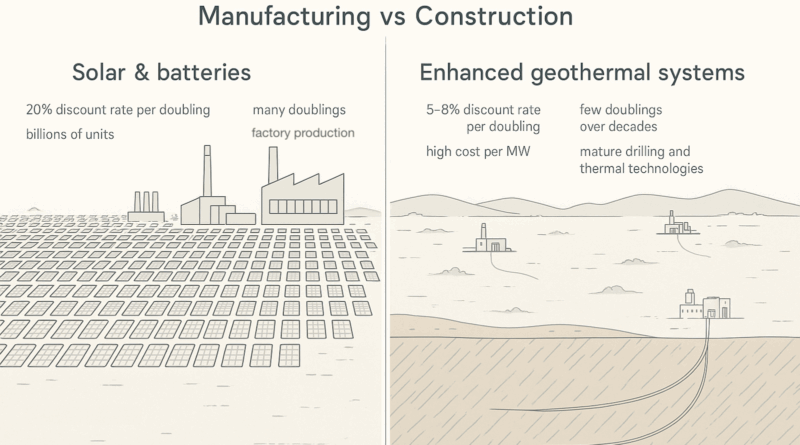
As the automotive industry transitions towards electric vehicles and renewable energy sources, one area of interest is enhanced geothermal systems (EGS) for their potential to provide firm, low-carbon electricity. However, a recent analysis by Michael Barnard questions whether EGS can follow solar’s cost trajectory due to fundamental differences in technology implementation.
Key Takeaways
- EGS relies on complex drilling and fracking techniques that do not benefit from the same economies of scale as high-volume manufacturing technologies like solar panels or batteries.
- The sparse, low-repetition nature of EGS projects means that cost reductions will be slower compared to mass-produced energy solutions.
- Policymakers and industry experts should reconsider optimistic projections for EGS cost declines based on the unique challenges of heavy infrastructure construction versus manufactured goods production.
Enhanced geothermal systems (EGS) aim to create artificial reservoirs in deep, hot rock where natural permeability is low. This involves drilling several kilometers underground and using hydraulic fracturing to open pathways for water circulation through the heated region. Once established, the system operates similarly to conventional binary or Organic Rankine Cycle (ORC) plants.
The concept of EGS has been compared to solar energy’s rapid cost reduction over time due to Wright’s Law, which posits that costs decline with each doubling of cumulative production. However, this pattern is less applicable to the construction-intensive nature of EGS projects, where economies of scale are harder to achieve.
Unlike high-volume manufacturing technologies such as solar panels or batteries, EGS projects involve unique site-specific challenges and require significant upfront investment in drilling and fracking infrastructure. This sparse, low-repetition approach means that cost reductions will be gradual rather than steep, making it unlikely for EGS to mirror the dramatic price drops seen in photovoltaic technology.
While advancements in directional drilling and hydraulic fracturing techniques can improve efficiency over time, these gains are incremental compared to the exponential improvements seen in manufacturing technologies. Policymakers and industry stakeholders need to adjust their expectations regarding cost reductions for EGS projects based on this understanding.
Frequently Asked Questions
Why can’t enhanced geothermal systems follow the same cost reduction pattern as solar?
The manufacturing of solar panels and batteries benefits from high-volume production, leading to significant economies of scale. In contrast, EGS projects involve site-specific drilling and construction that do not benefit from such large-scale replication.
What are the implications for policymakers regarding EGS?
Policymakers should be cautious about relying on optimistic cost projections for EGS. Instead, they should focus on realistic expectations based on the unique challenges of heavy infrastructure construction versus mass-manufactured technologies.
In conclusion, while enhanced geothermal systems hold promise as a scalable source of firm, low-carbon electricity, their cost trajectory is unlikely to mirror that of solar energy. The complex and site-specific nature of EGS projects means that cost reductions will be slower compared to mass-produced solutions like solar panels.
