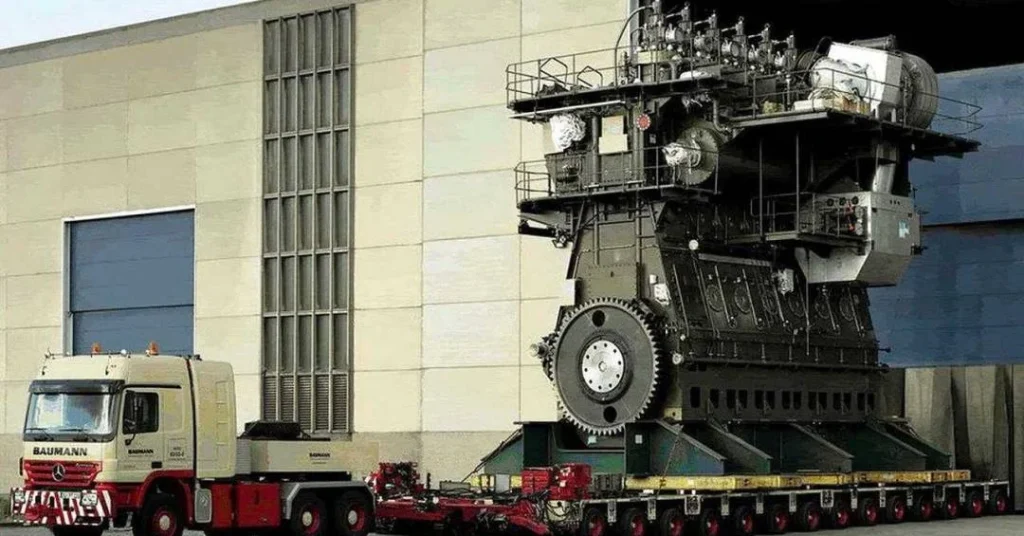
The Wärtsilä RT-flex96C is the world’s largest engine with an impressive output of 110,430 horsepower. This colossal diesel motor powers some of the biggest container ships on Earth.
Key Takeaways
- The Wärtsilä RT-flex96C has a power output of 110,430 hp and weighs in at 2,300 tons.
- This massive engine produces 775,376 kgfm torque, making it over two thousand times more powerful than the world’s most powerful truck motor.
- The RT-flex96C measures a staggering 13.5 meters high, equivalent to four floors of a building.
With its Common-Rail technology and heat recovery systems, the Wärtsilä RT-flex96C achieves surprising efficiency despite its enormous size. It’s designed for ocean-going vessels that carry over 14,000 containers each.
The engine’s volumetric capacity stands at a staggering 25,480 liters and runs on diesel fuel. Its torque output of 775,376 kgfm dwarfs the capabilities of even the most powerful trucks currently in production.
Developed by Finnish company Wärtsilä, this engine has been operational since 2006. It was necessary to surpass traditional twelve-cylinder engines due to increasing demands for cargo capacity and efficiency on sea routes.
The RT-flex96C is available with different configurations ranging from six to fourteen cylinders. Its design allows it to deliver the torque needed to move massive shipping containers across vast ocean distances efficiently.
Frequently Asked Questions
How does Wärtsilä RT-flex96C compare in size and power?
The engine is four stories tall, weighs 2,300 tons, and generates over two thousand times the torque of a typical truck motor. It’s twice as powerful compared to its nearest competitor.
What makes Wärtsilä RT-flex96C efficient despite being so large?
The engine uses Common-Rail technology and has advanced heat recovery systems, which significantly improve fuel efficiency even at such a massive scale. This allows it to operate effectively while moving enormous cargo loads.
As container shipping continues to grow in volume, the Wärtsilä RT-flex96C will remain crucial for transporting goods across global supply chains efficiently and reliably.
