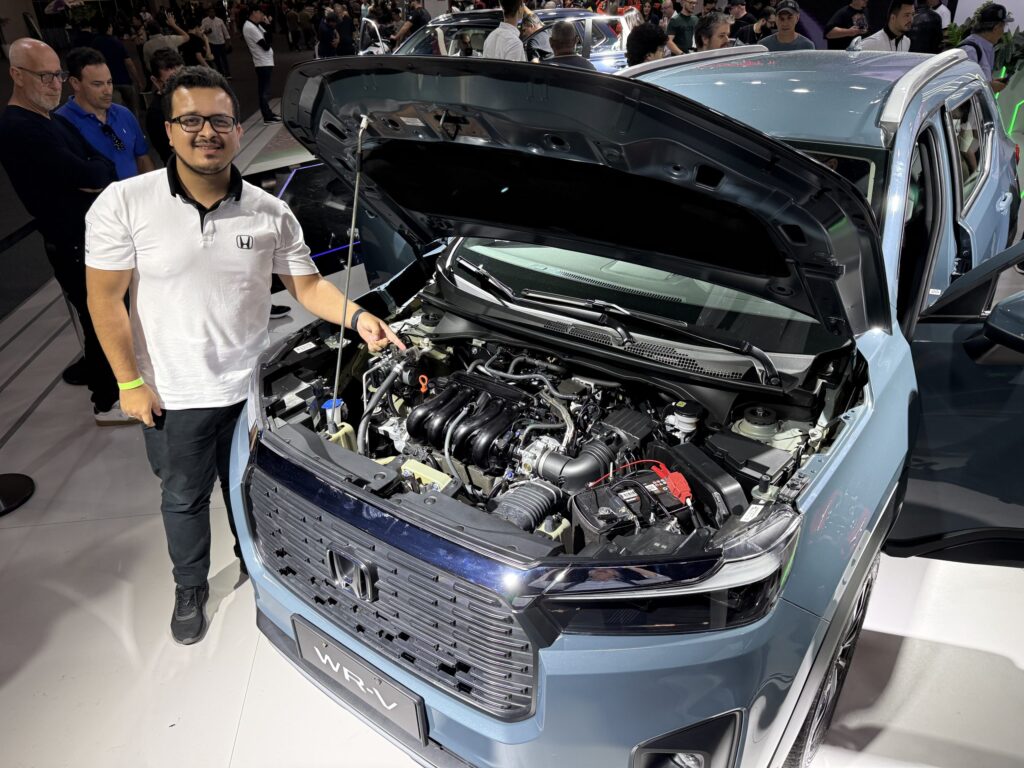
At this year’s São Paulo Motor Show, Honda showcased its latest SUV offering, the new WR-V, which is set to debut in Argentina next January. This model marks a departure from previous iterations as it no longer relies on the Fit platform but instead uses a homegrown design based on the Brazilian City’s chassis. The engine powering this trio of vehicles—City, WR-V, and HR-V—is a 1.5L i-VTEC inline-four that produces 121 horsepower and 145 Nm of torque.
Key Takeaways
- Honda employs the same engine across its City, WR-V, and HR-V models in South America.
- The 1.5L i-VTEC inline-four engine meets stringent emission standards.
- This motor is a departure from the trend of turbocharged three-cylinder engines with chain-driven camshafts.
During an interview at the São Paulo Motor Show, Renan Barba Dos Santos, Commercial Engineer for Honda South America, elaborated on the company’s decision to use this particular engine. He highlighted that it is part of a global strategy where the 1.5L i-VTEC powers entry-level models across Asia and other regions. The engine’s design ensures compliance with future emission regulations.
Notably, Honda has opted for a naturally aspirated setup rather than going the route of many competitors who use turbocharged three-cylinder engines with chain-driven camshafts. This choice sets Honda apart in a market where oil-bathed timing chains are becoming increasingly common due to their lower friction and improved reliability.
The new WR-V, positioned below the HR-V, is built on the Brazilian City’s platform and offers unique styling and features tailored for South American consumers. The vehicle’s engine configuration underscores Honda’s commitment to providing reliable and efficient powertrains that meet local market demands while maintaining a global standard of quality.
Frequently Asked Questions
What sets the 1.5L i-VTEC engine apart from other engines in its segment?
The 1.5L i-VTEC is a naturally aspirated, four-cylinder engine that meets stringent emission standards and offers consistent performance over time without compromising on reliability.
Why did Honda choose not to use oil-bathed timing chains?
Honda’s decision stems from its long-standing reputation for durability and reliability. The company believes in offering engines that are proven and reliable, even if they deviate from current trends.
In a market increasingly dominated by smaller, turbocharged engines with oil-bathed timing chains, Honda’s commitment to the 1.5L i-VTEC engine represents a nod to its rich history of engineering excellence and reliability. The company’s approach underscores the importance of proven technology in meeting consumer expectations for performance and longevity.
