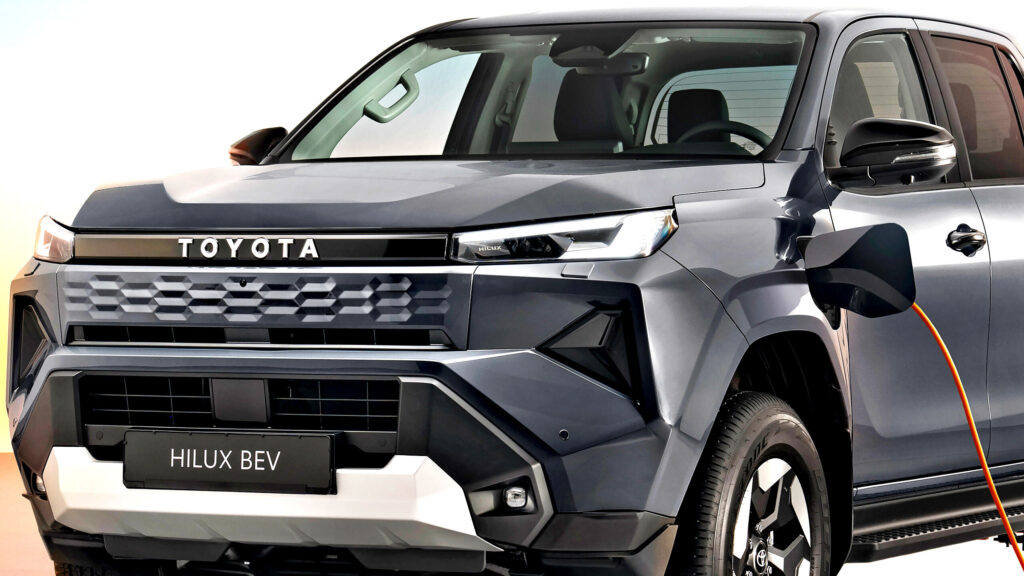
Imagine a future where the rugged Toyota Hilux, known for its durability and versatility in harsh terrains, transforms into an electric powerhouse. But is it affordable? Toyota promises that while the new battery-electric Hilux will be ‘attainable’, private owners might find it out of reach.
Key Takeaways
- The all-electric Hilux offers a range of 149 miles (240 km).
- Pricing is expected to be higher than diesel models, possibly adding AU$15,000 ($9,700) to the base price.
- Targeted mainly at fleet buyers and mining companies in Australia, with a planned release date for 2026.
The new Hilux BEV is built on Toyota’s ninth-generation platform and features a small yet powerful battery pack of 59.2 kWh that powers twin electric motors producing 193 hp. While this setup might seem modest in comparison to other EVs, it’s designed with specific applications in mind.
Sean Hanley, vice president for sales and marketing at Toyota Australia, emphasized the importance of affordability for fleet buyers. “We know this is not going to be our biggest seller,” he noted, but added that the pricing must still make sense for those who want it. The Hilux BEV will likely position itself near the top end of the Hilux range.
With a focus on mining operations and underground work, Toyota sees significant potential in this niche market. Large-scale mining companies are expected to be the primary customers due to the suitability of electric drivetrains for such environments.
Frequently Asked Questions
Will the Electric Hilux Be Available to Private Owners?
While Toyota hasn’t ruled out private sales, the initial target market will be fleet buyers and mining companies. The company aims for a balance between pricing and accessibility.
What Is the Expected Release Date for the Electric Hilux in Australia?
The all-electric Hilux is set to arrive in Australia during the first half of 2026, with Toyota targeting fleet buyers as its primary customers.
In conclusion, while Toyota’s electric Hilux promises exciting new possibilities for mining and industrial applications, it might not be an option for everyone just yet. The key will be finding that sweet spot where the vehicle is both attainable and practical for those specific markets.
