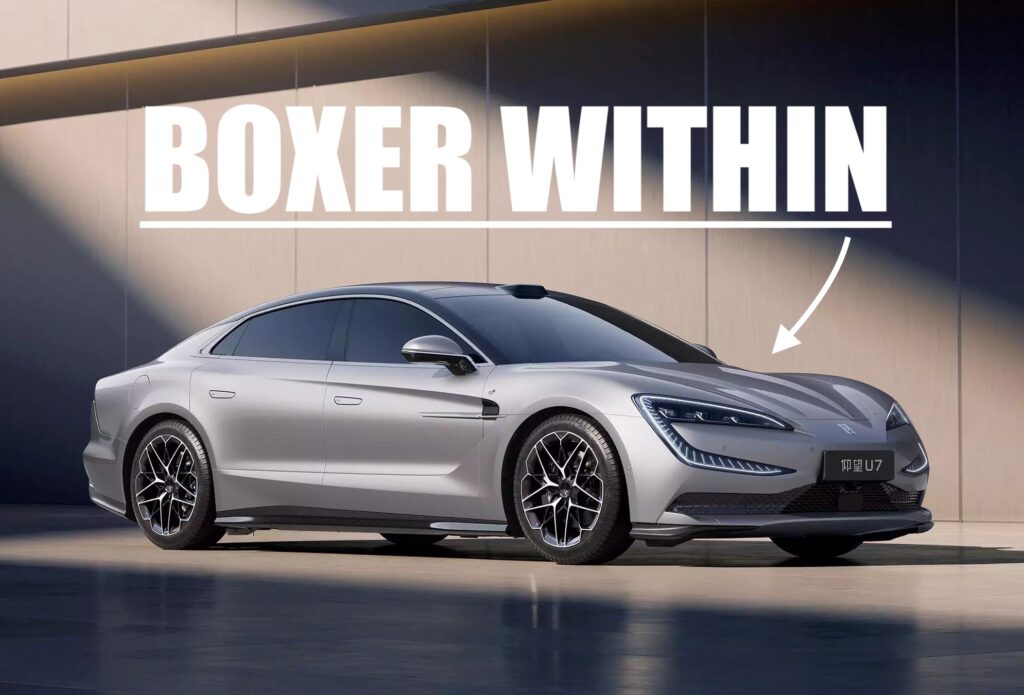
In a significant departure from the conventional, Chinese automaker BYD is set to introduce its own horizontally-opposed engine, commonly known as boxer engines due to their unique layout. This development marks a notable entry into an arena long dominated by Subaru.
The new BYD boxer four-cylinder, displacing 2.0 liters and designed for the e⁴ platform series of plug-in hybrid electric vehicles (PHEVs), represents a significant technological leap forward for the brand. Unlike its rival’s configurations primarily used in gasoline engines, this unit is engineered to serve dual roles: as both an internal combustion engine generator and as a direct power source under specific conditions.
BYD’s decision to develop such an engine was largely driven by packaging constraints. The compact design of the boxer configuration allows for better space management within the vehicle’s frontal compartment, aiding in maintaining sleek styling while preserving an EV-like low center of gravity essential for performance and handling characteristics.
The Yangwang U7 PHEV will be one of the first models to feature this innovative powertrain setup. It combines the 272 horsepower and 380 Nm torque output from the boxer engine with four electric motors, each driving a wheel independently. This combination ensures an impressive total system output exceeding that of most supercars, capable of propelling the U7 from 0 to 100 km/h in just under three seconds.
BYD has also focused on reducing noise and vibration (NVH) levels typically associated with internal combustion engines through advanced engineering techniques such as a dry-sump lubrication system and unique oil circulation management. This attention to detail ensures that the boxer engine’s presence is subtle, blending seamlessly into its electrically driven siblings.
Although the idea of an electrified vehicle featuring what some might consider a fuel-hungry design seems paradoxical at first glance, BYD’s approach underscores the versatility and adaptability required in modern automotive engineering. This development not only challenges traditional perceptions but also paves new avenues for hybrid powertrain configurations.
