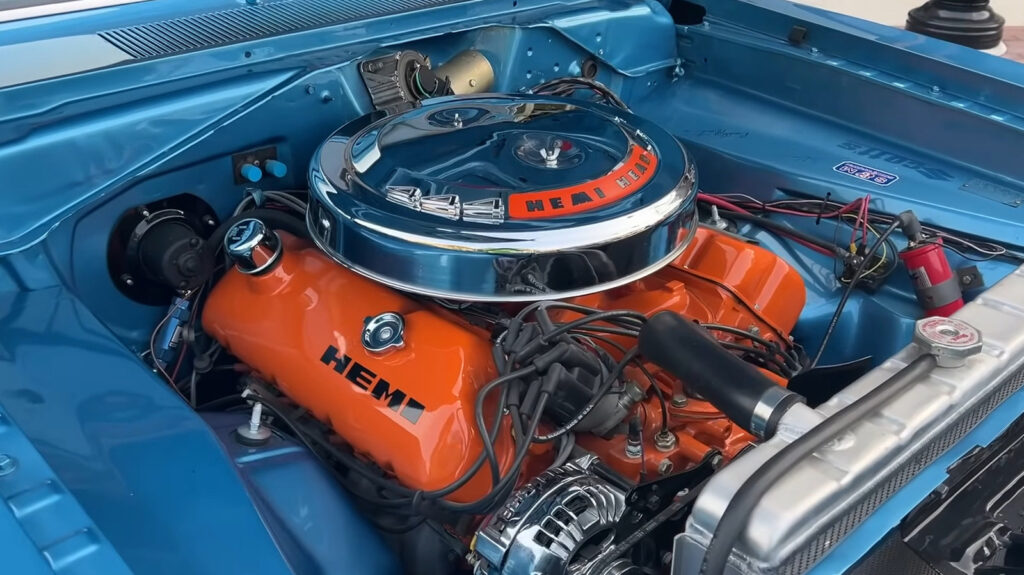
The Chrysler Ball-Stud Hemi, a project initiated in the late 1960s to replace its existing big-block engines, was an ambitious attempt to create a leaner and more efficient engine. However, despite its innovative design and potential performance advantages over competitors like Chevrolet’s Mark IV, it never made it past the prototype stage due to rising costs and changing market conditions.
Key Takeaways
- The Ball-Stud Hemi was designed to replace Chrysler’s 383, 400, 440, and 426 engines with two unified-displacement units of 400 and 444 cubic inches.
- Engineers aimed for near-Hemi performance without the weight and complexity issues associated with the original Hemi engine.
- The project faced significant challenges due to impending emissions regulations and an oil crisis that severely impacted the muscle car market.
The Ball-Stud Hemi was a radical departure from Chrysler’s traditional V8 design. It featured hemispherical combustion chambers, ball-stud rockers, and a canted valvetrain similar to Chevrolet’s Mark IV engine. This innovative approach aimed to reduce weight by 100 pounds compared to the 426 Hemi while also narrowing the engine’s width by 6.5 inches.
Despite its potential advantages in performance and efficiency, the Ball-Stud Hemi faced significant technical challenges. The head bolt pattern from Chrysler’s B-series block necessitated awkward S-shaped exhaust ports and non-true hemispherical combustion chambers. These compromises were deemed necessary to maintain compatibility with existing production lines but ultimately detracted from the engine’s purity of design.
Financial constraints and shifting market dynamics further hampered the Ball-Stud Hemi project. In 1969, Chrysler was grappling with rising tooling costs and impending emissions regulations that would severely restrict high-performance engines. The company’s decision to abandon the project reflected a broader trend in the industry where manufacturers were forced to prioritize compliance over performance.
While the Ball-Stud Hemi never reached production, it remains an intriguing chapter in Chrysler’s history. Its design philosophy and innovative features offer insights into the challenges faced by automotive engineers during a pivotal period of transition in the American muscle car era.
Frequently Asked Questions
Was the Ball-Stud Hemi more powerful than existing Chrysler engines?
The 444 cubic inch version reportedly outperformed the 440 engine but did not match the performance of the 426 with dual quads. This indicates that while it offered improved efficiency, it may have fallen short in raw power compared to Chrysler’s most powerful offerings.
Why didn’t Chrysler proceed with the Ball-Stud Hemi?
The project was abandoned due to rising costs and impending regulatory changes. The muscle car era was coming to an end, and Chrysler likely deemed it financially impractical to invest in a new engine family given the uncertain future of high-performance vehicles.
Chrysler’s Ball-Stud Hemi remains a fascinating case study in automotive engineering, showcasing the tension between innovation and practicality during a period of significant industry change. Its legacy continues to inspire discussions about the evolution of American muscle cars and the challenges faced by manufacturers adapting to new market realities.
