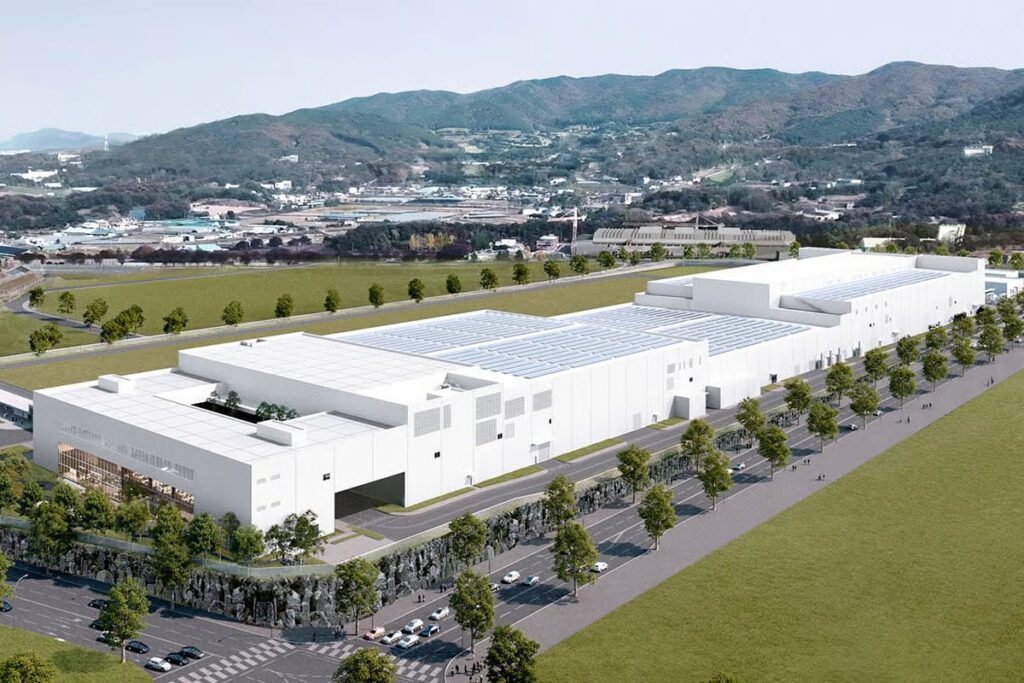
South Korean automotive giant Hyundai Group celebrated the topping-out ceremony for its new Future Mobility Battery Campus in Anseong, scheduled for completion at the end of 2026. The facility will serve as a comprehensive research and development hub dedicated to battery technology.
Key Takeaways
- The campus is set to open by late 2026 in Anseong, South Korea.
- Highest investment of 1.2 trillion won ($700 million) into battery R&D infrastructure.
- Covering nearly 20 hectares with a total floor area of 111,000 square meters.
The groundbreaking ceremony for the campus took place in January 2025. The Hyundai Group is investing approximately 700 million euros into this project to establish an advanced battery research and development infrastructure. This new facility will be the first of its kind within the group, focusing on next-generation batteries.
Hyundai’s existing R&D centers in Namyang and Uiwang have been dedicated to initial cell design and process technologies. In contrast, the Future Mobility Battery Campus aims to extend this research by conducting continuous process validation under real production conditions using state-of-the-art equipment.
The campus will focus on several key areas including replication of battery cell production processes, integrated testing environments for iterative validation, lifecycle testing across all stages from cells to vehicle integration, and development of high-performance lithium-ion batteries. Additionally, the facility aims to integrate digital tools and AI-driven technologies to enhance precision and efficiency.
Frequently Asked Questions
Will Hyundai produce its own battery cells at this new campus?
The company has not yet confirmed whether it will also manufacture batteries on-site. The primary focus is currently on research and development.
What kind of battery technologies will be researched at the Future Mobility Battery Campus?
The facility aims to develop high-performance lithium-ion cells for electric vehicles (EVs) and extended-range electric vehicles (EREVs), with future adaptations for diverse formats and materials.
This ambitious project underscores Hyundai’s commitment to advancing battery technology, positioning the company at the forefront of the global EV market. The Future Mobility Battery Campus is expected to significantly contribute to the development of next-generation batteries.
