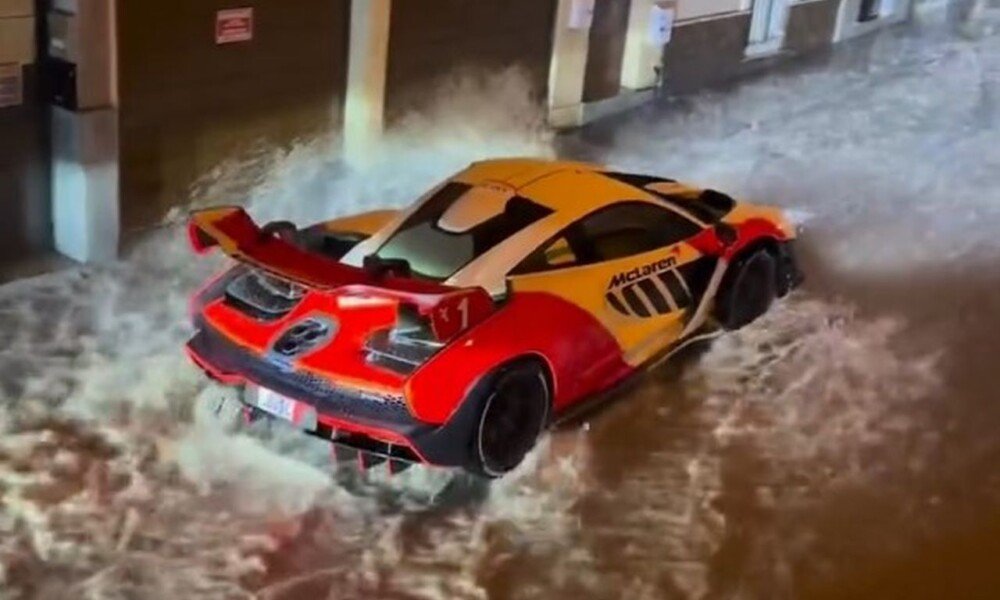
The sight of a McLaren Senna navigating the flooded streets of Malta is both remarkable and somewhat surreal. This supercar, known for its track-focused design, was captured driving through narrow Maltese roads that had turned into virtual rivers following recent heavy rainfall.
Key Takeaways
- The Senna, one of the most exclusive cars ever made by McLaren with only 500 units produced, was seen in Malta.
- The car’s distinctive red and white Formula 1 livery adds to its rare appearance on public roads.
- Despite being a track-oriented vehicle, the Senna managed to navigate through flooded streets without significant issues, showcasing its advanced engineering.
The McLaren Senna is a marvel of automotive engineering, built for high-speed performance and cornering excellence. Its aerodynamic design, featuring massive air intakes and diffusers, was clearly visible as it drove through the floodwaters. The car’s low profile and aggressive stance were accentuated by the water gushing into its various vents and flowing out through the rear diffuser.
Interestingly, this sighting of a Senna in Malta brings to mind earlier McLaren models like the F1, which also featured an aerodynamic design but with a different approach. The F1 was designed for ultimate road performance, while the Senna is more focused on track capabilities. Both cars are testaments to McLaren’s engineering prowess and their commitment to pushing the boundaries of automotive technology.
The Senna’s ability to handle such challenging conditions speaks volumes about its advanced suspension systems and tire technology. The car features a bespoke Pirelli P Zero Trofeo R tires, which provide exceptional grip in dry conditions but are also well-equipped for wet surfaces. Additionally, the sophisticated electronics that control the car’s stability and traction ensure it remains manageable even when driving through flooded streets.
While this incident highlights the Senna’s engineering capabilities, it also raises questions about its intended use on public roads. The vehicle is primarily designed to be driven on tracks where conditions can be controlled and optimized for performance. However, the fact that a Senna was able to navigate through such adverse weather conditions without apparent issues demonstrates the robustness of McLaren’s design philosophy.
Frequently Asked Questions
How many McLaren Sennas were produced?
The total production run for the McLaren Senna was limited to 500 units, making it one of the most exclusive cars ever made by the British manufacturer.
What is the top speed and power output of the McLaren Senna?
Powered by a 4.0-liter twin-turbo V8 engine producing 800 PS (790 hp) and 800 Nm of torque, the McLaren Senna has a top speed of over 340 km/h (211 mph).
The sight of a McLaren Senna driving through flooded streets in Malta is a testament to its engineering excellence. While it’s designed for track use, this incident showcases its adaptability and robustness under unexpected conditions.
