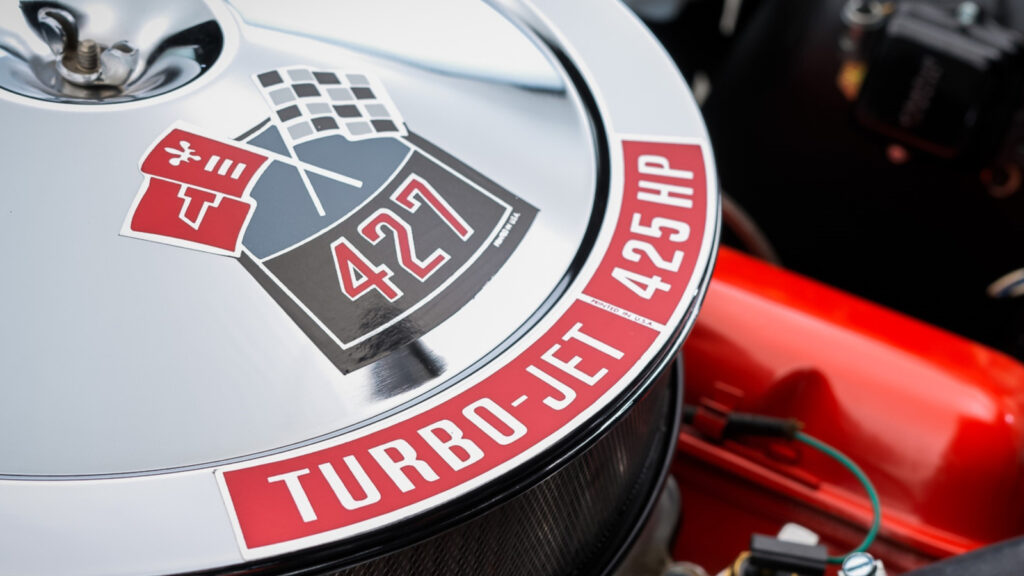
The automotive industry’s competitive spirit in the 1960s led to the production of numerous large displacement engines, with both Ford and Chevrolet introducing their versions of the 427 cubic-inch V8. Despite slight differences in actual displacement, these engines were pivotal in shaping performance car history.
Key Takeaways
- Ford’s 427 FE engine was marketed as a 427 despite having an actual displacement of 425.82 cubic inches, while Chevrolet’s 427 CI engine had the advertised displacement.
- The output figures for both engines were nearly identical, with Ford producing 425 horsepower at 6,000 rpm and 480 lb-ft torque at 3,700 rpm, compared to Chevrolet’s 425 hp at 5,600 rpm and 460 lb-ft torque at 4,000 rpm.
- Both manufacturers experimented with unique engineering solutions; Ford introduced a single overhead cam (SOHC) setup in 1964, while Chevrolet offered a wide range of performance tuning options for their 427 CI engine.
The Ford 427 FE and the Chevy 427 both emerged as significant players in the high-performance car segment during the mid-1960s. Both engines were designed to cater to a market hungry for power and speed, with each manufacturer pushing the boundaries of engine technology.
While the Ford 427 FE was marketed under the guise of being a 427 cubic-inch displacement engine despite having an actual displacement of 425.82 cubic inches, Chevrolet’s 427 CI engine accurately reflected its advertised size with a bore and stroke of 4.25 inches by 3.76 inches, yielding exactly 426.72 cubic inches.
Both engines boasted impressive power outputs: the Ford 427 FE produced 425 horsepower at 6,000 rpm and 480 pound-feet of torque at 3,700 rpm, while the Chevrolet L72 427 CI engine generated 425 hp at 5,600 rpm and 460 lb-ft torque at 4,000 rpm. Early versions of the Chevrolet L72 even offered a rating of 450 horsepower.
When it came to performance tuning options, Chevrolet’s 427 CI engine had a wider range compared to Ford’s offering. From sedate 10.25:1 compression LS1 engines producing 335 hp to the wild L88 variant with factory-rated 430 hp (likely more like 550+), Chevrolet catered to various performance needs. In contrast, Ford’s 427 FE was primarily aimed at high-performance applications and was not designed for relaxed cruising.
Frequently Asked Questions
What is the actual displacement of the Ford 427 FE?
The Ford 427 FE has an actual displacement of 425.82 cubic inches, despite being marketed as a 427 CI engine.
How does Chevrolet’s L72 427 compare in terms of power output?
The Chevrolet L72 427 CI engine produced 425 horsepower at 5,600 rpm and 460 lb-ft torque at 4,000 rpm. Early versions even had a rating of 450 hp.
In conclusion, the Ford 427 FE and Chevrolet 427 CI engines were both significant in their era, offering powerful performance options to car enthusiasts. While they shared similarities in output figures and design philosophy, each manufacturer brought unique features and tuning options that set them apart from one another.
